For decades, the technology industry chased a familiar ambition: build faster computers, create smarter software and connect more people. Progress often moved in waves. One breakthrough sparked another, industries adjusted and eventually a new normal emerged. But every generation experiences a moment when evolution stops feeling incremental and starts feeling transformational. We may be living through one of those moments now.
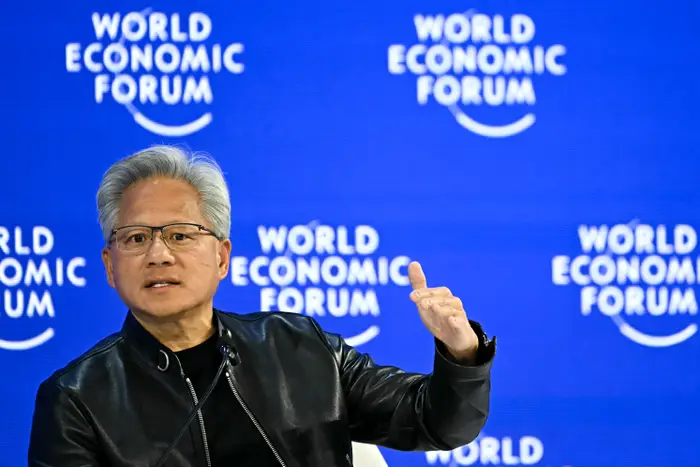
On stage at Dell Technologies World, amid conversations around artificial intelligence, infrastructure and the future of enterprise computing, the atmosphere carried the energy of an industry moving beyond experimentation and into reinvention. Standing at the center of that conversation was Jensen Huang, a man increasingly viewed not simply as a technology executive but as one of the principal architects of the AI era. Introduced as a partner, friend and visionary, the Nvidia leader arrived with characteristic ease and humor.
Before any deep technical discussion began, he jokingly reminded the audience of his regular presence at the event: “I’m here every year selling Dell.” The room laughed, but beneath the humor sat a reality far larger than a long standing partnership.
YOU CAN ALSO READ: Why Nigeria’s Central Bank Believes the Economy Can Withstand Global Shocks
For years, Nvidia supplied graphics processors powering gaming and advanced computing systems. Today, however, the company occupies a very different position. It sits at the center of a technological transition that may reshape industries, labor systems and the very architecture of modern work itself. According to Huang, the AI industry has reached a critical turning point, not the age of experimental AI, not the age of fascinating AI, but the age of useful AI.
Only two years ago, conversations around artificial intelligence largely focused on generative systems capable of producing text, images and content. Impressive as they were, much of their enterprise value still felt theoretical. Companies saw possibilities but struggled to identify practical applications at scale. Today, Huang believes something fundamental has changed. Generative AI evolved into systems capable of reasoning. Reasoning evolved into planning. Planning evolved into agents, autonomous systems capable of thinking, using tools, evaluating outcomes and continuously refining actions through iteration.
The implications are enormous. Unlike a chatbot simply responding to a question, an AI agent can work independently for extended periods, reassess strategies, call upon multiple tools and continue operating until objectives are achieved. That shift changes the economics of computing itself. According to Huang, computational requirements have expanded by factors previously difficult to imagine, not ten times or twenty times, but one hundred times or even a thousand times.
In some cases, an AI programming task can now run autonomously for an entire week, completing work that once required teams of engineers and months of human effort. The productivity gains are extraordinary. But so are the infrastructure demands.
This explosive growth explains why Huang repeatedly returned to one idea: demand. Demand, he argued, is becoming “utterly parabolic.” Not simply because models are becoming more capable, but because adoption itself is accelerating at remarkable speed. Across enterprises, AI agents are increasingly assisting software development, quality assurance, deployment systems, cybersecurity operations and internal workflows. Companies are embedding intelligence into processes once dependent entirely on human labor.
Inside Nvidia itself, Huang described a future where engineering no longer revolves around one person and one assignment. Instead, tomorrow’s exceptional engineer may become an orchestrator, managing networks of intelligent agents that themselves supervise additional agents. Human work may not disappear, but it may fundamentally change. And perhaps that transition is already underway.
Huang spoke candidly about how artificial intelligence has transformed expectations inside organizations. Projects that once required months now take weeks. Work that consumed weeks now takes days. Tasks requiring days increasingly happen in hours. And increasingly, even hours begin to feel too long. As speed expands, ambition expands with it.
One of the conversation’s most revealing moments arrived when Huang shifted from technology to personal reflection. Smiling, he spoke about his own evolving mindset. “The old Jensen wanted to make a contribution,” he said. Then came the punchline: “The new Jensen? I’ve got big ambitions now.”
The audience laughed, but beneath the humor sat a larger truth. Technology changes capability. Capability reshapes imagination. And imagination changes what individuals and organizations believe is possible.
The discussion soon shifted toward infrastructure, an area increasingly becoming the hidden battleground of the AI economy. For years, cloud computing dominated technology strategy. Companies rented computational power from distant servers and scaled consumption as needed. Artificial intelligence is beginning to challenge that model. Increasingly, organizations want intelligence closer to where work happens, local systems, private systems, secure systems and hybrid environments.
Huang described an architecture designed around that future: an ecosystem where AI models can operate locally inside enterprises while simultaneously accessing larger frontier models running across cloud environments. This approach creates flexibility at a moment when data sensitivity and computational demand are rising simultaneously.
The technical descriptions became increasingly sophisticated, systems supporting giant models with trillions of parameters, token generation architectures and infrastructure capable of operating across every major cloud environment. Yet beneath the engineering language sat a remarkably simple idea: computing itself is changing shape.
YOU CAN ALSO READ: Africa’s Future Will Not Be Imported – It Must Move Freely Across Borders
The traditional computer may no longer remain simply a productivity device. It may become a personal intelligence machine, a system capable of running agents, reasoning systems and autonomous workflows directly beside the user.
For decades, computing largely revolved around humans operating software. Now software increasingly operates alongside humans or perhaps even with them.
Near the close of the conversation, Huang offered another observation that may prove even more significant than processing power itself. In the past, he explained, people completed work and handed responsibilities to other people. In the future, individuals may supervise entire armies of intelligent agents. One person. Hundreds of agents. Possibly thousands.
The implications remain difficult to fully comprehend. Productivity could rise dramatically. Creativity could expand. Entire organizational structures could evolve. At the same time, long standing assumptions around labor, expertise and value creation may be rewritten.
By the time Huang and Michael Dell stood together signing hardware on stage, the atmosphere felt less like a product unveiling and more like a glimpse into a rapidly approaching future. Because beneath discussions about processors and infrastructure sat a larger question: if intelligence becomes abundant, available everywhere, on every machine and across every workflow, what becomes possible?
The answer may still be unwritten. But if Jensen Huang is right, computing is no longer entering its next chapter. It is beginning an entirely new book.